Project Overview
Accounts payable teams often spend significant time reviewing invoice information, confirming vendor status, checking purchase order requirements, identifying duplicate invoices, and determining whether an invoice is ready for processing.
This project demonstrates how automation can apply those controls consistently. Invoice data enters the workflow, vendor information is validated against an approved vendor master, invoice requirements are checked, and the transaction is routed either to an exception path or into QuickBooks Online for accounts payable processing.
Challenge
Reduce repetitive AP validation work while maintaining consistent vendor and invoice controls.
Solution
Build a Make.com workflow using webhooks, JSON, Google Sheets, business rules, routers, filters, Gmail, and QuickBooks Online.
Outcome
Created a repeatable validation process that separates exceptions from approved invoices and prepares validated transactions for processing in QuickBooks Online.
Project Visual
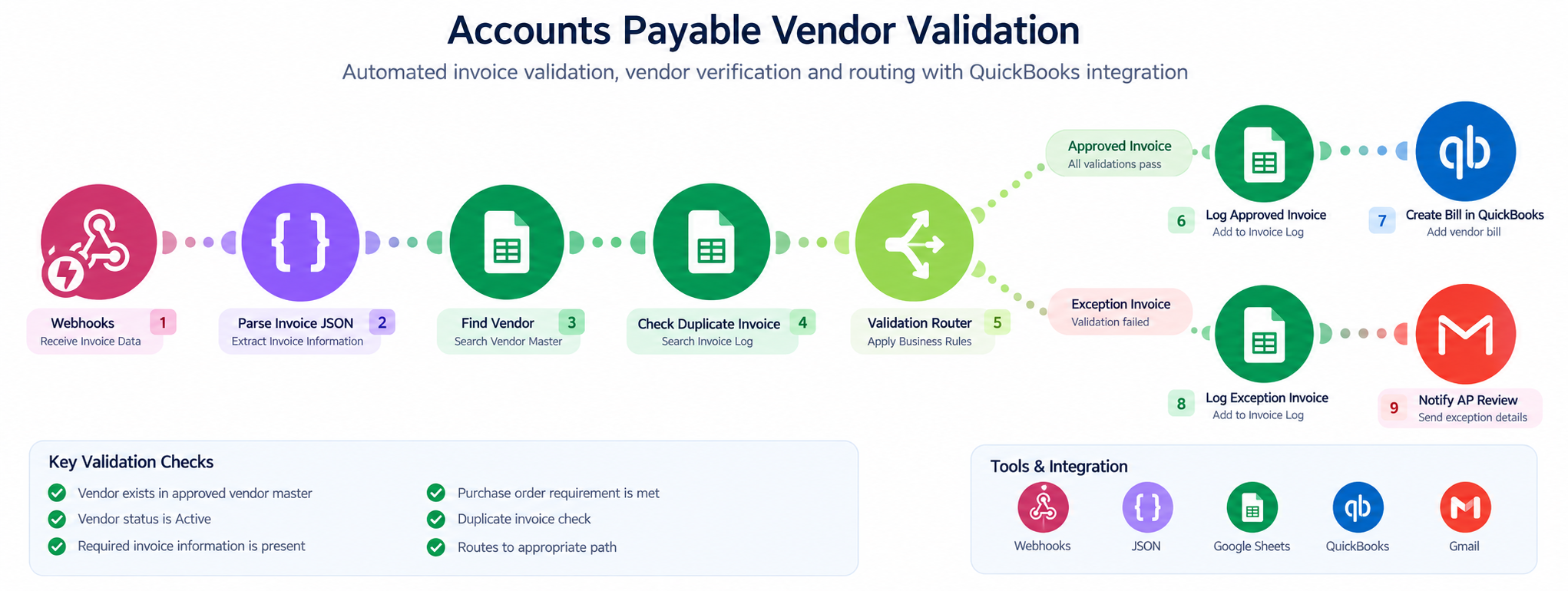
The workflow below illustrates how invoice information enters the automation, moves through vendor and invoice validation, and is routed to either an exception-review path or a QuickBooks Online processing path.
How the Automation Works
- A custom webhook receives structured invoice information.
- JSON parsing identifies fields including Vendor ID, Vendor Name, Invoice Number, Invoice Date, Amount, Purchase Order, Payment Terms, and Vendor Email.
- Google Sheets searches the Vendor Master using the Vendor ID.
- The workflow confirms that the vendor exists and is active.
- Required invoice fields and purchase order requirements are checked.
- The Invoice Log is searched by Vendor ID and Invoice Number to identify possible duplicate invoices.
- A router directs the invoice to either the approved path or the exception path.
- Approved invoice data is passed to the QuickBooks Online module for accounts payable processing.
- The approved transaction is recorded in the Invoice Log.
- Exceptions are logged and an automated Gmail notification is sent for human review.
Business Rules
- The vendor must exist in the approved Vendor Master.
- The vendor must be active.
- Required invoice information must be present.
- Purchase order requirements must be satisfied when applicable.
- The Vendor ID and Invoice Number combination must not already exist in the Invoice Log.
- Only invoices that pass validation are routed to the QuickBooks Online processing step.
- Invoices that fail a control are routed for exception review rather than continuing automatically.
QuickBooks Online Integration
QuickBooks Online serves as the financial system step after the validation controls have been completed.
The workflow is intentionally designed so invoice data does not move into QuickBooks until vendor, invoice, purchase order, and duplicate checks have passed.
This creates a clear control point between automated validation and downstream accounts payable processing.
Exception Management
Not every invoice should move into QuickBooks without review. Unknown vendors, inactive vendors, incomplete invoice information, missing required purchase orders, or duplicate invoice records are routed to an exception path.
The exception path creates visibility into the issue and sends a Gmail notification so the transaction can be reviewed before further processing.
Tools & Methods
Challenges & Problem Solving
One of the most important design considerations was determining which decisions could be automated safely and which conditions should be routed for human review.
Vendor validation required the workflow to compare incoming invoice information against a controlled vendor master rather than relying only on the information contained in the invoice.
Duplicate detection required a search of historical invoice records before approving a new transaction. The QuickBooks integration was positioned after these controls so it serves as a downstream processing step rather than bypassing validation.
Business Value
- Reduces repetitive manual vendor and invoice validation.
- Applies accounts payable business rules more consistently.
- Helps identify duplicate invoices before further processing.
- Improves visibility into invoices requiring additional review.
- Creates a structured exception-handling process.
- Provides a centralized invoice validation log for tracking and review.
- Connects validated AP information with QuickBooks Online for downstream processing.
Skills Demonstrated
Let's Connect
Interested in discussing operations, automation, process improvement, or professional opportunities? I'd be happy to connect.
Schedule a Conversation