Project Overview
Client onboarding often requires someone to review new submissions, determine which internal team is responsible, and manually forward the information to the correct group. As submission volume grows, this can create repetitive work, delays, and inconsistent handoffs.
This project demonstrates how automation can monitor incoming onboarding submissions, evaluate routing conditions, and automatically notify the appropriate operational team.
Challenge
Reduce manual review and routing of new client onboarding submissions across multiple internal teams.
Solution
Build a Make.com workflow that monitors new submissions, applies routing logic, and sends targeted notifications.
Outcome
Created a repeatable onboarding process that improves consistency, reduces manual coordination, and supports faster internal handoffs.
Project Visual
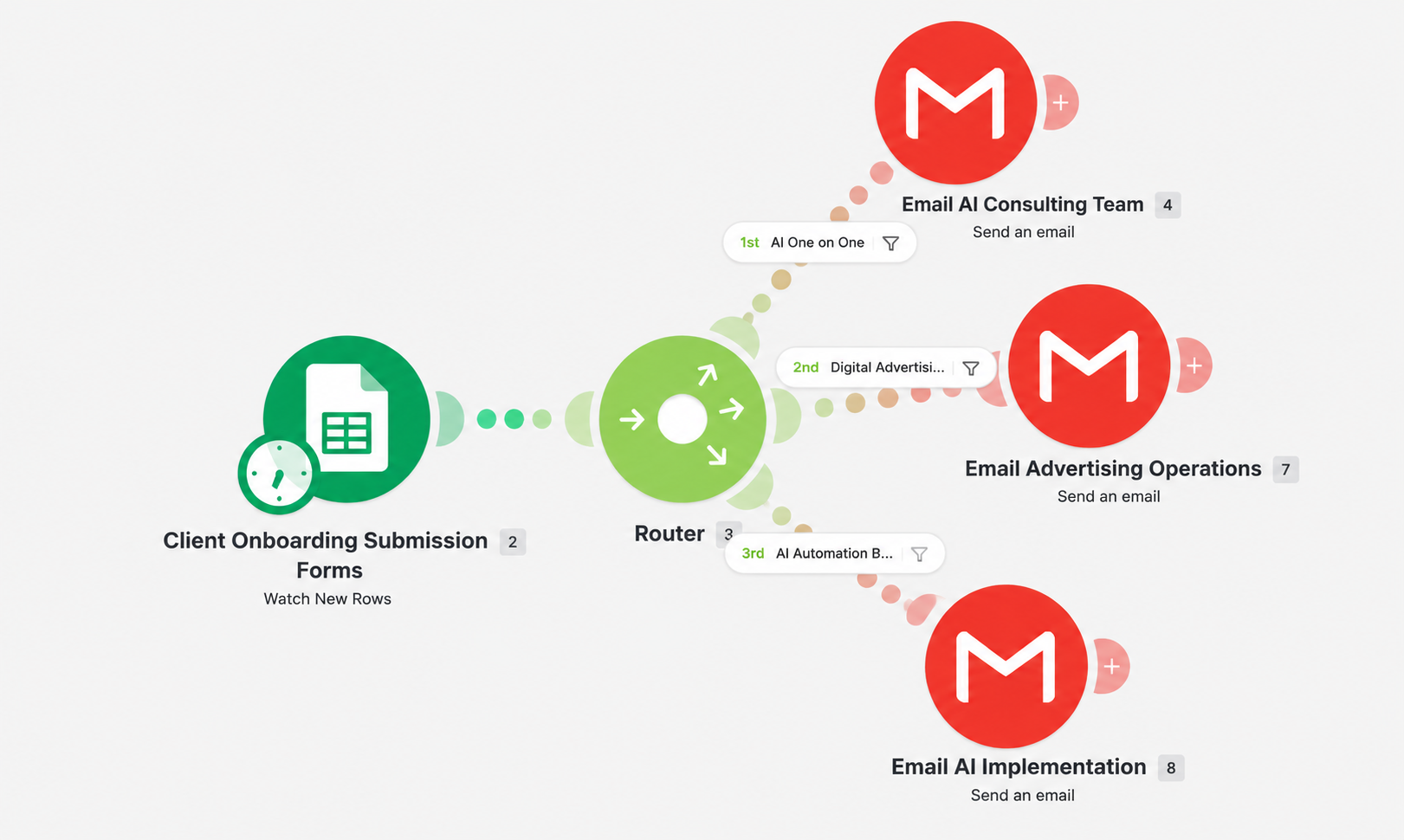
The workflow below shows how a new client onboarding submission is monitored, evaluated through routing logic, and directed to the appropriate operational team.
How the Automation Works
- Google Sheets monitors the client onboarding submission source for new records.
- When a new submission is detected, Make.com retrieves the onboarding information.
- A router evaluates the submission against defined business rules.
- The submission is directed into the appropriate workflow path based on the type of service or operational support required.
- The appropriate internal team receives an automated Gmail notification containing the onboarding information.
- The routing structure creates a more consistent handoff process without requiring someone to manually review and forward every submission.
Routing Logic
The core of this automation is the routing layer. Instead of treating every onboarding submission the same way, the workflow evaluates the information and sends it to the team responsible for the next step.
- AI consulting submissions are routed to the consulting team.
- Digital advertising submissions are routed to advertising operations.
- AI automation or implementation submissions are routed to the implementation team.
This approach allows one centralized onboarding process to support multiple operational paths while keeping the logic consistent and manageable.
Tools & Methods
Challenges & Problem Solving
One of the key considerations was making sure each submission followed the correct routing path. A workflow can run successfully from a technical perspective and still create operational problems if the routing logic is incorrect.
Testing therefore focused on validating each route independently, confirming that the correct conditions triggered the correct path, and verifying that the appropriate team received the expected notification.
The workflow was structured so additional onboarding paths could be added later without redesigning the entire process.
Business Value
- Reduces repetitive manual review and forwarding of onboarding submissions.
- Creates a more consistent internal handoff process.
- Helps ensure onboarding information reaches the correct operational team.
- Supports faster response times for new client submissions.
- Reduces dependence on individual staff members to remember routing requirements.
- Creates a scalable framework that can support additional teams or service categories.
Skills Demonstrated
Let's Connect
Interested in discussing operations, automation, process improvement, or professional opportunities? I'd be happy to connect.
Schedule a Conversation