Project Overview
Inventory processes can become difficult to manage when order activity and stock levels are tracked manually. Each order may require someone to locate the item, calculate the remaining quantity, update the inventory record, and determine whether the new balance requires attention.
This project demonstrates an automated workflow that monitors new orders, updates inventory quantities, evaluates low-stock conditions, and sends a notification when inventory requires follow-up.
Challenge
Reduce manual inventory updates and make low-stock conditions easier to identify.
Solution
Connect Google Sheets, Make.com, HTTP, webhooks, and Gmail in a parent/child automation design.
Outcome
Created a repeatable process that updates inventory automatically and notifies the appropriate person when stock falls below a defined level.
Project Visual
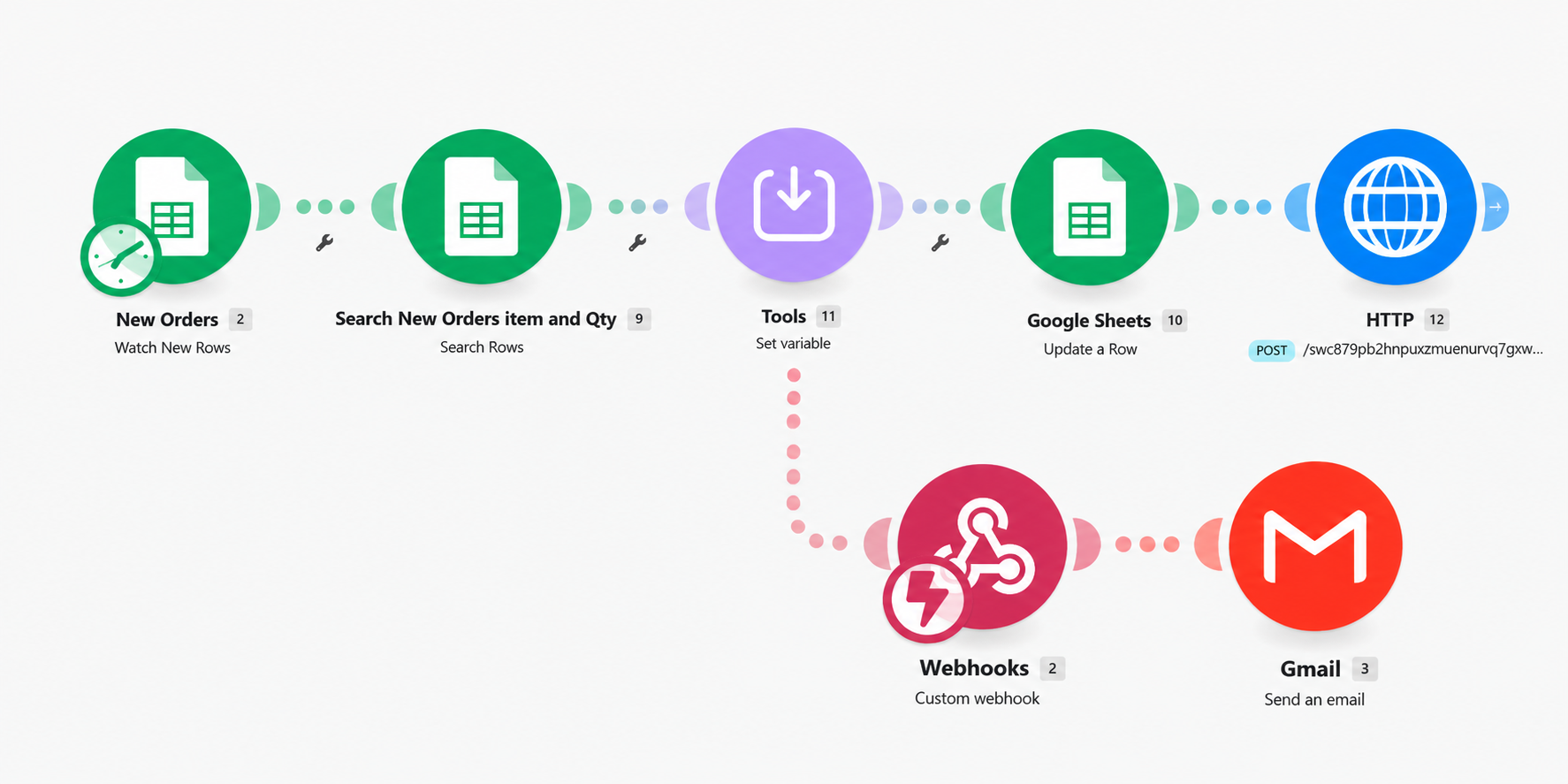
The workflow below shows the main inventory scenario that monitors new orders, calculates inventory changes, updates the inventory record, and triggers a secondary notification workflow when stock is low.
How the Automation Works
- Google Sheets watches the New Orders sheet for newly added order records.
- The workflow searches order and inventory information to identify the item and ordered quantity.
- A Tools step calculates and stores the updated inventory value.
- Google Sheets updates the corresponding inventory row with the new stock level.
- A low-inventory filter determines whether the updated quantity requires attention.
- If the condition is met, an HTTP POST sends the low-stock information to a connected webhook.
- The secondary Make.com scenario receives the webhook data.
- Gmail sends an automated low-inventory notification.
Business Rules
- Only new order records should trigger the inventory-update process.
- The ordered item must be matched to the correct inventory record.
- The ordered quantity is used to calculate the remaining stock level.
- The inventory record is updated before the low-stock rule is evaluated.
- The secondary notification workflow runs only when the low-inventory condition is met.
Parent / Child Workflow Design
The solution separates inventory processing from notification delivery. The main scenario handles the order and inventory logic, while a second scenario receives low-stock information through a webhook and sends the Gmail alert.
This design keeps each workflow focused and makes it easier to expand the notification process later without redesigning the inventory logic.
Tools & Methods
Challenges & Problem Solving
One challenge was ensuring that each order updated the correct inventory record and that the remaining quantity was calculated before the low-stock condition was evaluated.
Separating the low-inventory notification into a webhook-driven secondary scenario also required testing the data passed between the two workflows and confirming that notifications were triggered only when the defined condition was met.
Business Value
- Reduces repetitive manual inventory updates.
- Improves consistency in stock-level calculations.
- Provides faster visibility into low-inventory conditions.
- Creates a reusable notification workflow through webhook integration.
- Supports more proactive inventory management and reorder planning.
- Demonstrates integration between spreadsheet data, HTTP requests, webhooks, and email.
Skills Demonstrated
Let's Connect
Interested in discussing operations, automation, process improvement, or professional opportunities? I'd be happy to connect.
Schedule a Conversation